
In moments of political uncertainty, the world often finds itself watching closely as leaders test the limits of power, rhetoric, and public imagination. Recent remarks attributed to Donald Trump have sparked intense discussion, not only because of their unusual nature but also because they raise deeper questions about leadership, sovereignty, and the evolving perception of democracy in a globalized age.
According to widely circulated accounts, Trump suggested that if he were unable to pursue another presidential term in the United States, he might consider running for office in another country—specifically pointing to Venezuela. The idea, while surprising, has prompted debate across political, academic, and media circles.
The United States operates under constitutional limits, particularly the Twenty-second Amendment, which restricts presidents to two terms. This framework exists to prevent the concentration of power and ensure leadership rotation.
Trump’s remark, whether symbolic or serious, introduces a broader question: can political identity or leadership transcend national boundaries?
The discussion becomes even more complex when viewed alongside tensions in U.S.–Venezuela relations, especially involving Nicolás Maduro and ongoing political instability in the country.
Venezuela today represents more than a nation—it symbolizes debates about democracy, intervention, and sovereignty. Referencing it in political rhetoric adds weight and interpretation beyond the literal meaning.
At its core, this situation highlights:
- The power of political messaging
- The importance of perception in leadership
- The fragility of democratic norms under pressure
Ultimately, whether such remarks are interpreted as strategy, humor, or ambition, they reflect a changing political landscape where influence, identity, and communication are increasingly global.
Tragic Hospital Incident Highlights Urgent Strain on Emergency Healthcare Systems
A critical situation escalated when a young man was brought to the hospital in urgent need of care. Witnesses described a scenario requiring immediate medical intervention.
At the time, hospital staff were already overwhelmed. Overcrowding in the emergency department delayed response times, and valuable minutes passed before treatment could begin.
Despite the efforts of medical personnel, the patient’s condition worsened. Tragically, he passed away in the hospital corridor before receiving the necessary care.
Hospital officials later expressed deep sorrow and acknowledged key contributing factors:
- The facility was operating beyond capacity
- Multiple critical cases were being handled simultaneously
- Overcrowding impacted response times
An internal review has been launched, alongside a broader investigation by health authorities. The focus includes:
- Emergency response timelines
- Staffing levels
- Resource availability
- Interdepartmental coordination
This case highlights systemic issues affecting healthcare systems globally:
- Overcrowding
- Staff shortages
- Limited infrastructure
- Delays in emergency care
Beyond statistics, this is a human tragedy—a life lost too soon and a family left grieving.
Public reaction has been strong, with concerns about access to timely care and growing pressure on healthcare workers. Experts are now calling for reforms such as:
- Expanding hospital capacity
- Hiring more medical staff
- Improving emergency procedures
- Investing in infrastructure
The incident serves as a wake-up call: healthcare systems must evolve to meet increasing demands.
Melania Trump Speaks Out: Drawing a Line Against Epstein Allegations
In a rare public statement, Melania Trump addressed allegations tied to the scandal surrounding Jeffrey Epstein.
Known for her privacy, Melania Trump firmly denied any involvement beyond incidental social encounters. She emphasized that claims circulating online are inaccurate and damaging.
The controversy resurfaced as old images and social connections involving figures like Ghislaine Maxwell began circulating again, fueling speculation.
However, official investigations into Epstein’s activities have not produced evidence linking Melania Trump to wrongdoing.
Her response highlights:
- The impact of misinformation in the digital age
- The difficulty of separating fact from speculation
- The importance of personal narrative and reputation
This moment marks a shift in her approach—from silence to direct engagement—aimed at reclaiming control over her public image.
“Cuba Is Next”: Media Reaction and Reality
During a public appearance in Miami, Donald Trump made a brief remark: “Cuba is next.”
Although he later downplayed it, the phrase quickly spread across media platforms, sparking speculation about U.S. policy toward Cuba.
Interpretations varied:
- Some saw it as a signal of potential escalation
- Others viewed it as political rhetoric or performance
In reality, U.S.–Cuba relations are shaped by complex factors:
- Economic sanctions
- Diplomatic efforts
- Internal conditions in Cuba
The situation in Cuba remains challenging, with economic hardship and public frustration affecting daily life.
This moment illustrates how:
- A single phrase can shape global perception
- Media amplification can distort context
- Public interpretation often diverges from reality
The key takeaway: rhetoric matters—but context matters more.
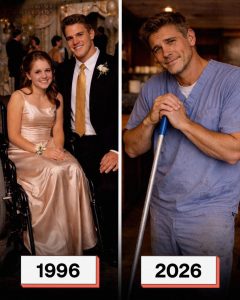
The Boy Who Danced With Me at Prom
Six months after an accident changed my life, I went to prom expecting to feel invisible.
Instead, one person made a simple choice that stayed with me for thirty years.
At seventeen, my life had been ordinary—until a car accident left me seriously injured. Recovery was long, difficult, and uncertain.
By prom night, I didn’t want to go. I feared being seen differently. But with encouragement from my mother, I showed up.
At first, I sat on the sidelines, watching others dance.
Then a boy approached me.
He didn’t hesitate. He didn’t treat me differently. He simply asked me to dance.
When I said I couldn’t, he replied: “Then we’ll figure out what dancing looks like.”
And we did.
That moment—simple, kind, genuine—changed how I saw myself.
Years later, after building a career and moving forward with my life, I met him again by chance.
The same kindness was still there.
That’s when I realized:
It wasn’t just about that night.
It was about being seen.
It was about someone choosing kindness when it mattered most.
And sometimes, that’s enough to change a life.
Leave a Reply