
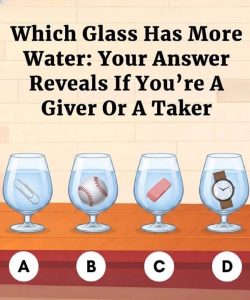
At first glance, the puzzle seems extremely simple. Four identical glasses—labeled A, B, C, and D—are filled to the same visible water level. Inside each glass sits a different object:
- Glass A: a paperclip
- Glass B: a baseball
- Glass C: an eraser
- Glass D: a wristwatch
The challenge is simple:
Which glass actually contains the most water?
Most people immediately assume all four contain the same amount because the water levels appear identical. But the puzzle is designed to trick the eye.
The Key Principle: Water Displacement
When an object is placed into water, it takes up space and pushes water aside. This is called displacement.
The larger the object inside the glass:
- the more space it occupies
- the less room remains for actual water
So even though all four glasses show the same water height, they do not contain the same amount of water.
The Correct Answer
The glass with the smallest object contains the most water.
That means:
✅ Glass A (the paperclip) holds the greatest amount of water.
The paperclip takes up almost no space, leaving nearly the entire glass available for water.
Why the Other Glasses Hold Less Water
- Glass B (baseball): occupies the most space, so it contains the least water.
- Glass C (eraser): medium-sized object, so medium water volume.
- Glass D (wristwatch): larger and more complex shape, displacing more water than expected.
Why This Puzzle Tricks People
The puzzle works because the human brain relies heavily on visual shortcuts. Seeing equal water lines makes us assume the quantities must also be equal.
But hidden variables matter.
This puzzle is really about:
- critical thinking
- questioning assumptions
- looking beyond first impressions
Final Answer
🏆 Glass A contains the most water because the paperclip displaces the least amount of space.
Leave a Reply