
Some images become meaningful not because of dramatic action, but because of stillness. A formal public setting, carefully arranged symbols, composed expressions, and a pause suspended in time can reveal as much as a speech.
This scene appears to capture such a moment.
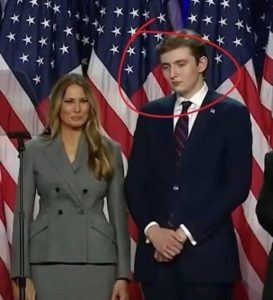
Rows of United States flags fill the background in orderly repetition. Their symmetry creates a strong visual rhythm—disciplined, ceremonial, unmistakably intentional. They are more than decoration. They signal nationhood, continuity, and institutional authority.
In the foreground stand two formally dressed figures, facing forward with controlled posture and neutral expressions. Nothing appears rushed. The scene feels measured, deliberate, and aware of its own significance.
The Setting as Message
Public events are rarely accidental in their design. Backgrounds, staging, lighting, and symbolism are chosen carefully because visual language matters.
Flags in repetition communicate stability and unity. They transform an ordinary room into a civic stage—one associated with leadership, governance, responsibility, or national attention.
Even without knowing the exact event, the setting itself tells viewers this is a moment intended to be seen and interpreted.
Stillness and Public Presence
The figures appear composed, neither celebratory nor visibly tense. That neutrality is common in public life, where restraint often replaces spontaneity.
In highly visible moments, posture can carry meaning:
- Standing straight can signal confidence or readiness
- Stillness can suggest discipline or solemnity
- A measured expression can communicate control under scrutiny
Public figures understand that silence, glances, and gestures are often analyzed as closely as spoken words.
Generational Symbolism
One of the most notable elements is the apparent age contrast between the two people in frame.
That difference introduces a symbolic layer often present in civic imagery: continuity across generations.
One figure may evoke experience, institutional memory, and familiarity with public responsibility. The other may represent emergence, transition, or the future taking shape in visible spaces.
Whether intentional or not, such pairings often resonate because societies naturally read public images through themes of legacy and succession.
Clothing as Civic Language
Formal attire also communicates. Structured suits, muted tones, and conventional styling often emphasize seriousness over individuality.
In ceremonial or political environments, clothing is frequently meant to support the institution rather than compete with it. Personal style becomes secondary to the collective message.
That visual restraint reinforces the tone of duty, discipline, and occasion.
Why Images Like This Spread
When viewers repeatedly share or discuss a still frame, it is usually because the image leaves room for interpretation.
People examine:
- proximity between subjects
- expressions
- body orientation
- eye direction
- symbolic background elements
A single photograph can become larger than the moment itself because observers project narratives onto what they see.
This is especially true in the digital era, where circles, arrows, captions, and cropped images can redirect attention and create new stories around an ordinary frame.
Public Role, Private Humanity
Despite the formal setting, the people pictured remain individuals navigating a highly managed environment.
That tension—between human presence and institutional symbolism—is often what makes such images compelling.
Behind composed faces may be fatigue, reflection, pride, stress, boredom, or concentration. Viewers rarely know. The ambiguity creates fascination.
The Power of Quiet Moments
History is often associated with speeches, votes, or dramatic announcements. But many lasting impressions come from pauses:
- waiting before an event begins
- standing after something significant was said
- silent acknowledgment during ceremony
- transitional moments between official acts
Stillness can carry weight because it invites people to look more closely.
Conclusion
This frame is powerful not because it shows action, but because it captures presence within a symbolic space.
It reflects how public life operates through choreography as much as words: placement, posture, background, timing, and visual meaning.
The image invites reflection on continuity, responsibility, generational change, and the human beings who stand inside larger systems.
Sometimes the quietest moments become the most discussed—not because they explain everything, but because they leave just enough unsaid.
Leave a Reply