
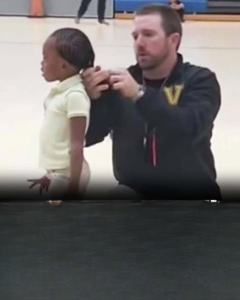
Inside a busy elementary school gym in Valdosta, what seemed like an ordinary school day turned into a moment that touched people far beyond the classroom walls.
Children were participating in a kindergarten basketball activity—running, laughing, learning coordination, and enjoying the noisy energy that often fills a school gym. Among them was physical education teacher Jonathan Oliver, focused on guiding students through the game and making sure everyone felt included.
During a pause in the activity, one student, Kristen, approached him with a simple problem.
Her hair was getting in her face.
It was bothering her while she played, and she asked if he could help put it into a ponytail.
Without hesitation, Oliver stepped aside from the game, knelt down to her level, gently gathered her hair, and tied it back so she could continue comfortably.
To him, it was nothing extraordinary.
It was simply helping a child who needed assistance.
There was no performance, no attempt to draw attention, and no sense that anything unusual had happened. It was one of those quiet moments that teachers handle every day—small needs that matter greatly to the children experiencing them.
But someone nearby recorded the interaction.
When the short video was later shared online, it quickly spread across social media. Viewers from around the country responded emotionally to what they saw: a teacher showing patience, kindness, and care in the middle of an ordinary school day.
In a digital world often dominated by conflict and negativity, the clip stood out because it captured something deeply human.
A child asked for help.
An adult responded with kindness.
That was all.
Yet for many people, it meant much more.
Parents praised the trust and compassion shown in the moment. Educators pointed out that scenes like this happen constantly in schools but often go unnoticed. Many adults shared memories of teachers who once helped them in similarly small but meaningful ways—tying shoes, calming fears, fixing clothing, or offering encouragement when it was needed most.
Kristen’s mother also responded warmly, explaining that the gesture reflected the kind of teacher Oliver already was. For those who knew him, the moment was not surprising—it was consistent with how he cared for students daily.
As the story gained wider attention, it became symbolic of something larger: the unseen work teachers do beyond lessons and textbooks.
Teaching young children often means shifting roles constantly.
Instructor.
Mentor.
Protector.
Problem-solver.
Comforter.
Sometimes all within the same hour.
The ponytail itself was never the real story.
The real story was attentiveness.
A teacher noticed that a small barrier was preventing a child from participating fully—and removed it with patience and kindness.
That simple act helped a student feel comfortable, confident, and ready to join in again.
For many viewers, that is what made the moment unforgettable.
It reminded people that education is built not only through curriculum and instruction, but through trust, empathy, and care.
Not every important moment in a school is graded.
Not every lesson comes from a whiteboard.
Sometimes the most lasting impact comes from gestures so small they could easily be overlooked.
A tied shoelace.
A calming word.
A helping hand.
Or a ponytail fixed in the middle of a noisy gym.
In the end, what resonated most was the quiet message behind it:
Kindness does not need to be dramatic to matter.
Often, the smallest acts leave the deepest impression.
Leave a Reply